

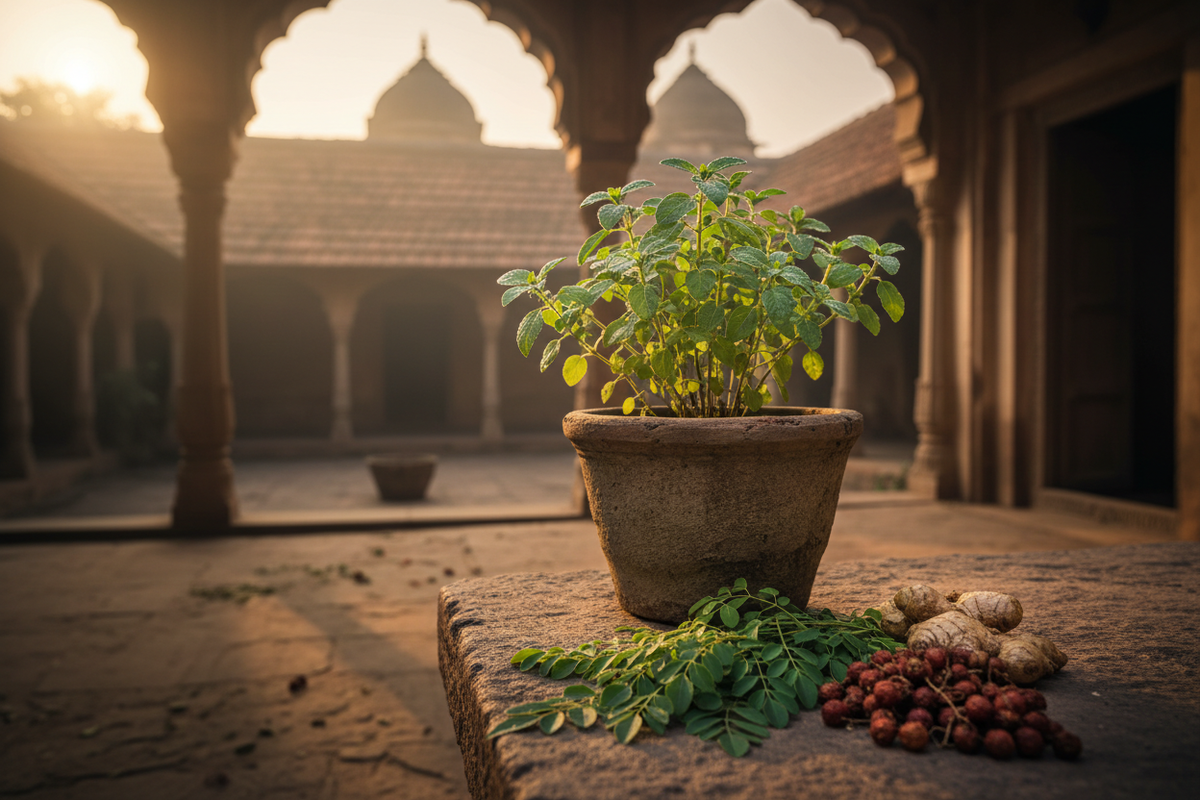
Before moringa became a superfood, it was simply the tree in the backyard.
Every house in South India seemed to have one: tall, unassuming, its feathery leaves catching the morning light. Nobody talked about nutrition profiles at the kitchen table. The aunties added drumstick to sambar, dried the leaves, and mixed them into rice because that was how the family cooked.
There is something quietly moving about watching the ingredients of our childhood return to attention.
Tulsi grew in every courtyard, not as a supplement but as a sacred presence. The plant was watered every morning, circled with a diya at dusk, and occasionally plucked for a warm cup with ginger and honey. No measuring spoons. No timers. Just instinct, flavour, and a preparation learned by watching.
Ginger, adrak, was never exotic. Fresh ginger went into chai and everyday cooking. Dry ginger flakes were simmered when a slower, deeper ginger flavour was wanted. Both belonged in the kitchen without fanfare.
Triphala appeared in many Ayurvedic households as a familiar three-fruit preparation, passed from one generation to the next along with the instructions for using it.
This is how knowledge survived. Through spoons and stories.
I think about my mother's kitchen in the way some people think about temples. There was reverence in the grinding stone worn smooth from decades of use, the steel containers lined by the stove, and the smell of mustard seeds, curry leaves, and something slow-cooking for everyone coming home.
Nothing in that kitchen felt accidental. Every ingredient had a place. Every combination carried the logic of lived experience and family taste.
Food was more than fuel. It was memory and the invisible thread connecting us to the people who came before us and the land they lived on.
When you eat moringa, drink tulsi, or reach for ginger, you are participating in preparations that have lived in Indian kitchens for generations.
That is not a small thing.
The ingredients never disappeared. They remained in markets, gardens, and recipes that became harder to make time for. What changed was how often we noticed them.
Now people are returning to familiar ingredients, not only from nostalgia but from curiosity. They are asking clear questions: What is in this? Where does it come from? How do I prepare it?
The answers often lead back to the same place: the backyard moringa tree, the courtyard tulsi plant, and the brass dabba on the highest shelf.
Back to a spoonful of tradition.
Sendriya Life was built on the belief that India's botanical heritage is not a relic. Every ingredient carries history, flavour, and the responsibility of being described honestly.


