

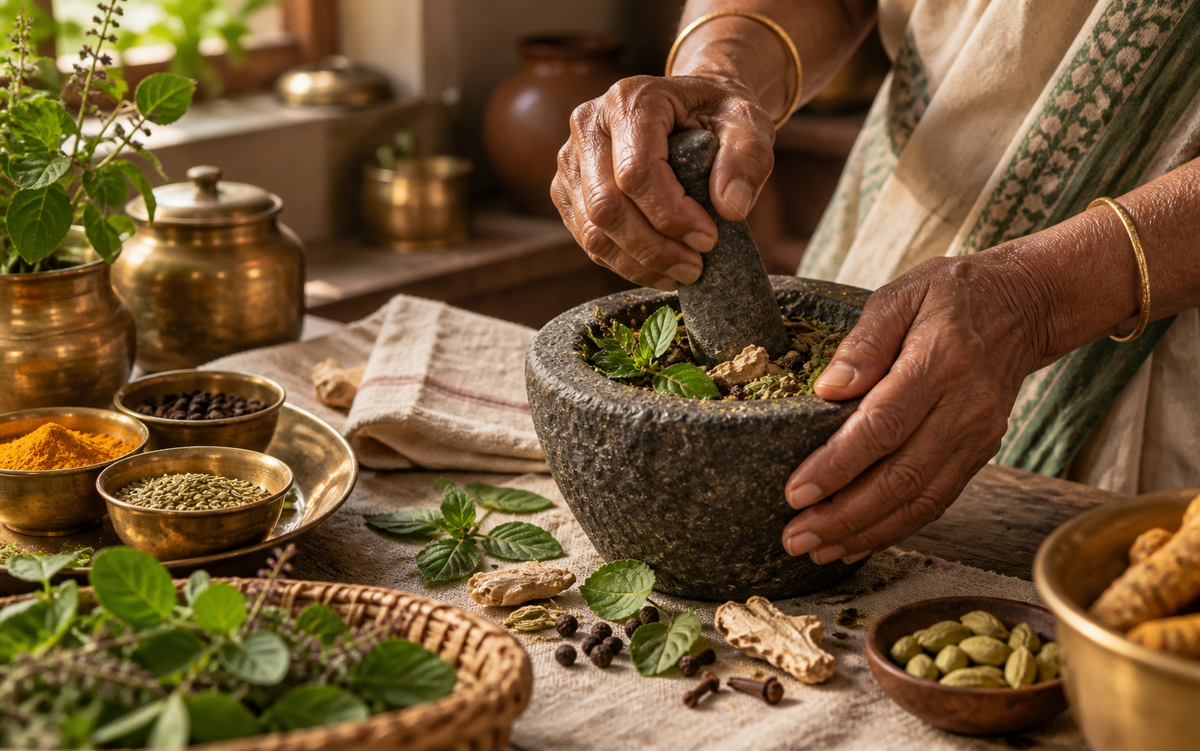
There was a woman in every Indian household who never needed a search bar.
She woke before the sun did. Before the pressure cooker hissed, before the milk boiled over, before the children stirred, she was already in the kitchen. She moved with a quiet certainty that felt less like routine and more like ritual. She knew which leaf brought which aroma, which spice belonged in the dal, and what to add to warm milk when the nights turned cold.
Our grandmothers did not carry degrees or cite studies. They carried generations of observation, passed down through spoken instructions, practised hands, and the patience that comes from paying attention.
In my grandmother's kitchen in Rajasthan, there was a small brass dabba on the highest shelf. It was never labelled. It did not need to be. She knew every compartment by touch: dry ginger flakes for chai and kadha, ajwain for the tadka, and a small bundle of dried tulsi leaves collected from the courtyard plant.
"Pehle ghar ka khayal," she would say. First, take care of home.
It was trust in familiar ingredients, the rhythm of the seasons, and the value of food prepared with attention.
This knowledge was never written down in our family. It lived in the hands that rolled moringa leaves with jaggery for the children. It lived in the voice that said, "Let this cool before you drink it." It lived in the smell of a kitchen where something was always simmering, not just food but care.
The tragedy of our generation is not that we forgot these things. It is that many of us were never taught them in the first place.
Somewhere between the rush of modern life and the promise of convenience, the brass dabba was put away. The courtyard tulsi plant was replaced by a potted one that nobody watered. Early morning rituals gave way to alarm clocks and instant coffee. The quiet, unhurried knowledge of our grandmothers began to fade.
Ayurveda was never meant to be a passing trend. In many homes, it appeared through ordinary choices: seasonal meals, familiar herbs, gentle preparation, and attention to how food felt at different times of year.
Our grandmothers often practised these traditions without naming them. They simply called it ghar ka khayal, taking care of home.
What strikes me most, looking back, is how unhurried it all was. There was no urgency to optimise or perform wellness. There was only the steady act of nourishment: a warm glass of haldi doodh, a handful of soaked almonds, and hing blooming in the dal for its unmistakable aroma.
These were not grand gestures. They were small, consistent acts of love.
We live in an age of information, yet we can feel disconnected from the ingredients in our own kitchens. We scroll through advice and chase changing trends while the most useful questions remain simple: What is this? Where did it come from? How is it traditionally prepared?
The things our grandmothers knew were not secrets. They were familiar practices that lived through repetition.
Perhaps it is time to listen again.
At Sendriya Life, we believe the wisdom of Indian kitchens deserves to be honoured, not forgotten. Our work begins with simple ingredients and clear information, because some traditions are worth preserving with care.


