

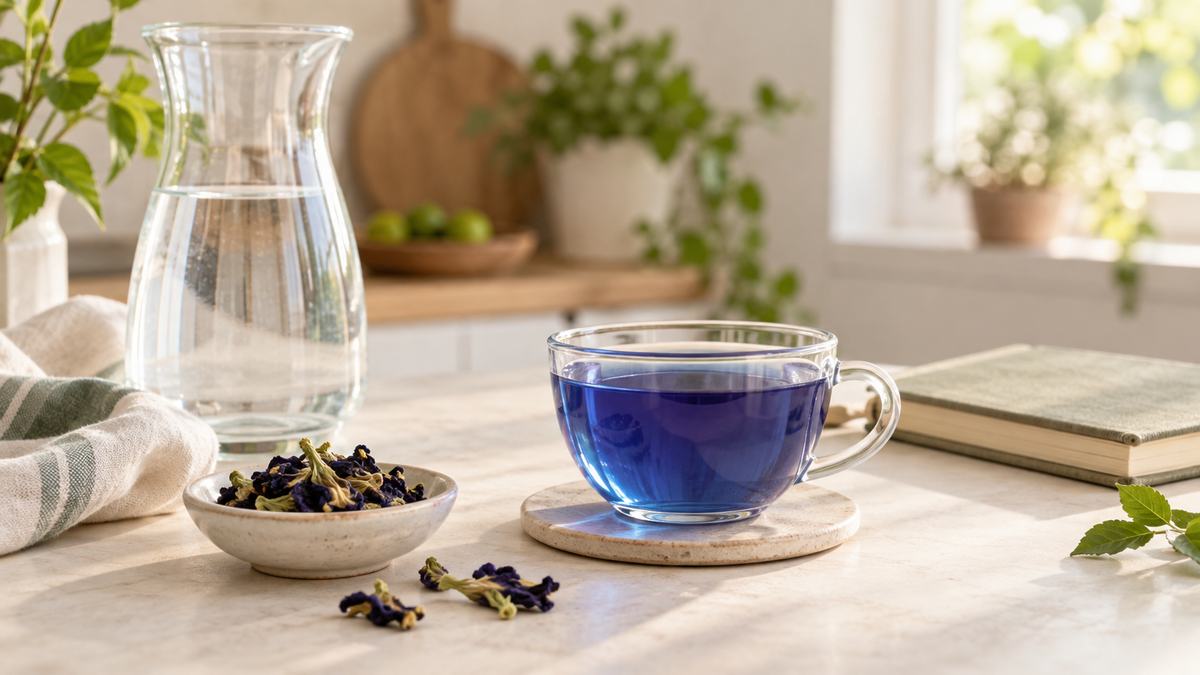
For most healthy adults, an occasional normally brewed cup of butterfly pea flower tea is a food-style use, but strong evidence defining an ideal daily amount or long-term safety is limited. “Natural” does not mean suitable for every person. Pregnancy, breastfeeding, childhood, allergies, chronic conditions and medicines are reasonable reasons to ask a qualified professional before making any herb a daily routine.
Butterfly pea has a long history of culinary use in parts of South and Southeast Asia, and its pigments are studied as natural food colours. That history supports its role as an ingredient, but it does not establish that multiple strong cups every day will prevent or treat disease.
What do human studies actually tell us?
Research on Clitoria ternatea includes laboratory studies, animal studies, food-colour research and a much smaller number of human trials. One randomized crossover trial studied a butterfly pea flower beverage alongside a sucrose drink in healthy men and examined short-term glycaemic response and antioxidant capacity. A single acute trial cannot define long-term health outcomes, universal safety or a daily dose.
This distinction is central to responsible reading:
- Laboratory antioxidant activity shows what compounds can do in a test system.
- Animal research can guide questions but does not automatically predict human effects.
- Extract studies may use concentrations far above a household infusion.
- Human trials are most directly relevant but remain limited for ordinary butterfly pea tea.
Does the FDA food-colour listing prove the tea has health benefits?
No. The US FDA lists butterfly pea flower extract as a colour additive permitted for specified food uses, including teas. This is useful regulatory evidence about a defined ingredient used under listed conditions. It is not an approval of marketing claims about weight loss, memory, diabetes, anxiety or other medical outcomes.
How much butterfly pea tea is reasonable?
There is no universally established evidence-based daily dose for home-brewed butterfly pea tea. A sensible food approach is to begin with one normal cup made according to the product guidance: a small pinch in about 200 ml water for 5 to 7 minutes. Pay attention to how you feel before considering more.
Avoid the assumption that stronger is automatically better. Highly concentrated brews increase exposure without proving extra benefit and may be less pleasant. Variety is also valuable: water, milk, soups and other unsweetened drinks can all contribute to hydration.
Who should be more cautious?
Pregnant or breastfeeding people
High-quality safety data for regular butterfly pea tea use during pregnancy and breastfeeding are limited. Culinary use in small amounts and daily concentrated use are not the same question. Ask an obstetric clinician before turning it into a routine.
People taking medicines or managing a condition
If you use medicines for blood sugar, blood pressure, clotting or another chronic condition, discuss regular herbal use with a clinician or pharmacist. The concern is not proof that a normal cup will cause harm; it is that individual circumstances and medicine combinations are not well mapped by general food articles.
Children
Children have different body sizes and health needs. Do not use butterfly pea tea to treat sleep, concentration, digestion or another concern without paediatric guidance. Keep hot drinks and whole dried flowers away from young children.
People with allergies
Any botanical food can cause an individual reaction. Stop using the product and seek urgent care for symptoms such as difficulty breathing, facial swelling or widespread hives.
What side effects should you watch for?
Reliable population-level side-effect rates for brewed butterfly pea tea are not well established. A new food can still cause digestive discomfort, headache, dizziness or an allergic reaction in an individual. Introduce one new ingredient at a time, use a normal strength and avoid combining multiple unfamiliar herbs on the first day.
Can butterfly pea tea replace medicine?
No. A colourful herbal infusion is not a substitute for prescribed treatment, medical evaluation or a nutritionally complete diet. Claims that blue tea cures diabetes, rapidly burns fat or reverses disease go beyond the evidence. If a health metric changes, discuss it with the professional managing your care rather than changing medicine independently.
How can you make daily use more sensible?
- Choose a single-ingredient, food-grade product.
- Follow the pack’s brewing guidance.
- Begin with one normal cup rather than a concentrate.
- Limit added sugar if the drink is part of an everyday routine.
- Store dried flowers dry, airtight and away from light.
- Do not continue using an ingredient that causes symptoms.
- Review regular herb use with a clinician if you take medicine.
Why food use and extract research need separate decisions
A cup brewed from a small pinch of flowers is not equivalent to a concentrated powder, capsule or laboratory extract. Products can differ greatly in composition and dose even when they share the same plant name. Safety information from one form cannot automatically establish a daily amount for another.
If you make blue tea a routine, keep the preparation consistent and notice repeatable changes rather than attributing every good or bad day to the drink. Record the product, amount, timing and any symptoms. This simple approach gives a clinician more useful information if you later need advice.
Frequently asked questions
Can I drink butterfly pea tea at night?
Pure butterfly pea tea is caffeine-free, so it does not introduce caffeine at bedtime. That does not make it a proven sleep treatment. Keep the portion comfortable so the liquid itself does not disturb sleep.
Does blue tea help with weight loss?
No tea guarantees weight loss. Replacing a sugary beverage with an unsweetened infusion may reduce that drink’s energy contribution, but lasting weight change depends on the broader pattern of food, activity, sleep and health.
Does lemon make it safer or healthier?
Lemon changes acidity, colour and flavour. It does not remove every possible risk or convert the drink into a treatment.
Can I drink it on an empty stomach?
Some people tolerate it, while others find any herbal drink uncomfortable on an empty stomach. Begin with a mild cup after food if you are sensitive.
Is more blue colour better?
No. Colour depth mainly reflects pigments and brewing conditions. It is not a home test of clinical potency.
Reference sources
- Randomized crossover trial of a butterfly pea beverage in healthy subjects
- Review of butterfly pea anthocyanins and applications
- US FDA regulatory status for butterfly pea flower extract
Continue exploring Butterfly Pea Flower Tea (Aparajita)
Ready to make your own cup? View Sendriya Life Butterfly Pea Flower Tea (Aparajita) – 40g for the current ingredient declaration, pack information and availability.
This article provides general food and wellness information. It is not medical advice and does not replace care from a qualified health professional.


