

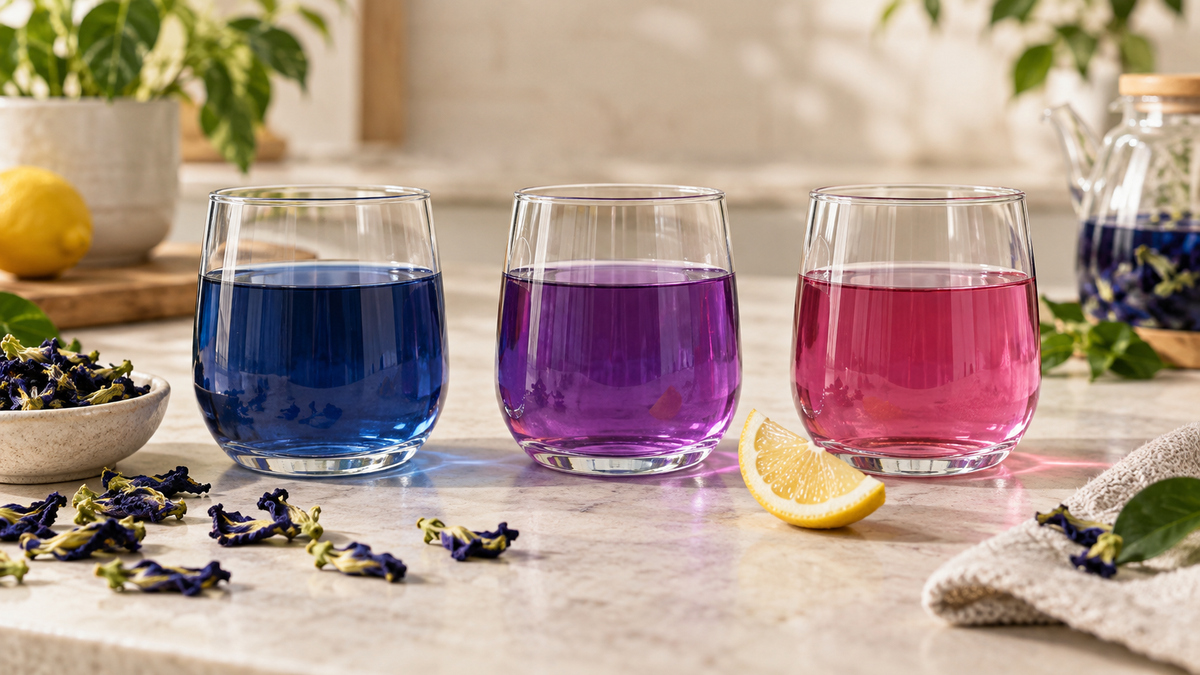
Butterfly pea tea changes colour because its natural anthocyanin pigments respond to pH. In roughly neutral water the infusion looks blue. Add an acidic ingredient such as lemon and the pigment structure changes, moving the colour towards violet, purple or pink. It is a natural chemical response, not a reaction that requires artificial dye.
The experiment is beautiful, but it is also useful: it explains why two people can brew the same flowers and get different shades. Tap water, filtered water, lemon quantity, flower strength, steeping time and storage can all influence what you see.
Which pigment makes butterfly pea tea blue?
Butterfly pea flowers contain anthocyanins, a broad family of water-soluble plant pigments. The characteristic pigments in Clitoria ternatea include polyacylated anthocyanins called ternatins. Their chemical structures can exist in different forms depending on the concentration of hydrogen ions in the surrounding liquid—in everyday language, its pH.
These structural shifts change which wavelengths of visible light the molecules absorb and reflect. Our eyes interpret the result as a new colour. That is why the transformation can happen immediately when lemon juice disperses through the cup.
What colour appears at different pH levels?
| Liquid condition | Likely colour direction | Kitchen example |
|---|---|---|
| More acidic | Pink to magenta | More lemon or lime |
| Mildly acidic | Violet to purple | A few drops of citrus |
| Near neutral | Blue to blue-cyan | Plain drinking water |
| More alkaline | Greenish tones may appear | Not recommended as a drinking experiment with unknown chemicals |
Exact shades are not universal. Flower variety, pigment concentration, lighting and camera settings matter. A published educational experiment using butterfly pea extract demonstrated distinct pink, purple, blue, cyan, green and yellow zones across a wide pH range, but your kitchen cup contains a much narrower and food-safe set of conditions.
Why does lemon turn blue tea purple?
Lemon juice contains acids, especially citric acid. Adding it lowers the drink’s pH. As the environment becomes more acidic, ternatin molecules shift towards forms that appear violet or pink. A small amount usually produces purple; a larger amount can push the cup further towards magenta while also making the flavour more tart.
Add lemon after the flowers have been strained. This lets you see the original blue, control the flavour and compare the transformation. It also prevents the citrus from masking whether the base infusion brewed cleanly.
A simple colour-change method
- Brew a strong but drinkable blue infusion using a small pinch of flowers and 200 ml hot water.
- Steep covered for 5 to 7 minutes and strain.
- Divide the tea among three clear glasses.
- Leave the first plain.
- Add two or three drops of lemon to the second and stir.
- Add a little more lemon to the third and compare the shade and taste.
Use only familiar edible ingredients. Butterfly pea tea can be an indicator, but a beverage is not the place to experiment with cleaning chemicals, concentrated alkalis or unknown solutions.
Why did my tea brew purple before adding lemon?
Your water may already be mildly acidic. Water from different filters and regions has different mineral content and pH. Residue from lemon, vinegar or a dishwasher rinse aid in the cup can also affect the result. Some flowers may naturally produce a slightly violet blue.
Rinse a clear glass thoroughly and compare filtered water with your usual water. The goal is not to force a laboratory-perfect colour—it is to understand why natural variation occurs.
Why does the colour fade or turn dull?
- Light exposure: anthocyanins are less stable under prolonged light, so store flowers away from windows.
- Old or damp flowers: humidity and long storage can reduce quality.
- Too much water: a highly diluted infusion will look pale even when correctly brewed.
- Long holding time: fresh infusions look livelier than drinks kept uncovered for many hours.
- Other ingredients: milk, herbs, fruit and sweeteners change opacity and perceived colour.
Does hotter water make the tea bluer?
Hot water helps extract water-soluble pigments, but hotter is not endlessly better. A normal hot infusion is sufficient. Very prolonged boiling can flatten the delicate flavour and does not guarantee a prettier shade. Standardise flower quantity, cup volume and time before changing temperature.
Does the colour change alter the caffeine?
No. Pure butterfly pea flowers are naturally caffeine-free, and adding lemon does not create caffeine. If the product includes green tea, black tea or another caffeinated ingredient, that caffeine remains whether the drink is blue or purple.
Does a darker colour mean more health benefits?
Not necessarily. A darker cup may simply contain more flowers or less water. Laboratory antioxidant tests and pigment measurements cannot be translated into a promise that a darker household brew will produce a specific health outcome. Enjoy the visual chemistry as part of the food experience.
A simple kitchen experiment that keeps the science honest
Brew one pot, divide it equally among three clear glasses and leave the first untouched. Add a few drops of lemon to the second and a little more to the third. The progression from blue towards violet and pink demonstrates that acidity—not a hidden flavour—is changing how the pigments interact with light.
Use only normal food ingredients. Do not add household cleaners, concentrated alkalis or unknown powders to a drink. If you want to compare water sources, label the glasses outside the drink and keep every other variable—flower amount, water volume, steep time and lighting—the same. That turns a colourful trick into a repeatable observation.
Frequently asked questions
Will lime work instead of lemon?
Yes. Lime is also acidic and usually shifts the blue infusion towards violet or pink. The flavour will be slightly different.
Why did honey not change the colour?
Honey sweetens the cup but may not be acidic enough, in the amount used, to create an obvious shift. Lemon or lime provides a clearer demonstration.
Can I reverse the colour change?
Raising pH can shift anthocyanin colour again, but do not add unknown alkaline substances to a drink. For a safe kitchen presentation, brew a fresh blue portion instead.
Can I make layered blue and purple lemonade?
Yes. Chill the components, fill the glass with ice and pour slowly. Differences in sugar concentration and density help layers remain visible briefly before mixing.
Will the colour stain cups?
It normally rinses from glass and glazed ceramic. Porous materials, pale fabrics and grout may stain, so wipe spills promptly.
Reference sources
- Butterfly pea flower tea as a pH indicator
- Molecular study of butterfly pea tea phenolics and pH
- Review of ternatins and butterfly pea colour stability
Continue exploring Butterfly Pea Flower Tea (Aparajita)
- Butterfly pea tea taste, caffeine and uses
- How to brew butterfly pea tea
- Butterfly pea tea safety and daily use
Ready to make your own cup? View Sendriya Life Butterfly Pea Flower Tea (Aparajita) – 40g for the current ingredient declaration, pack information and availability.
This article provides general food and wellness information. It is not medical advice and does not replace care from a qualified health professional.


