

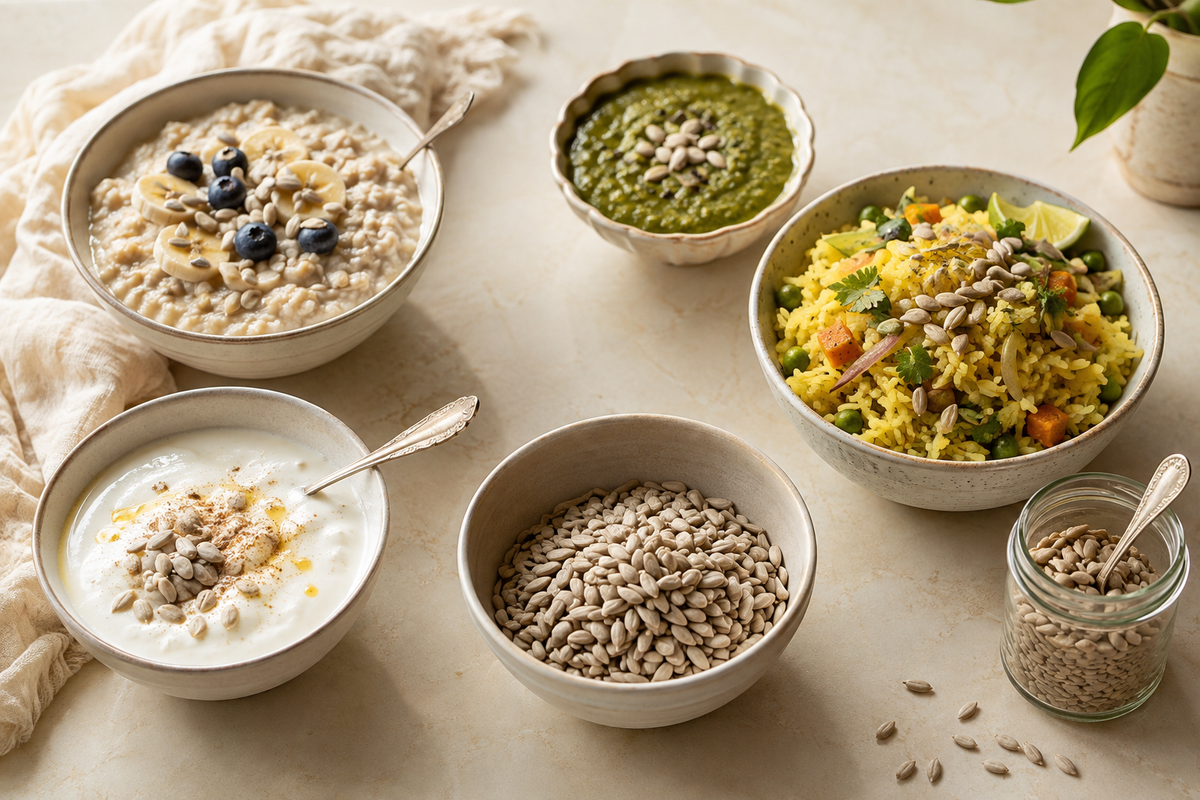
Sunflower seed kernels are mild, crisp and easy to fit into familiar meals. You can sprinkle them over breakfast, grind them into chutney, mix them into atta or turn them into a simple snack. Their flavour is subtle enough to work with cumin, curry leaves and chilli as easily as it works with fruit, cardamom and jaggery.
The ideas below use shelled kernels—the pale grey or beige inner seeds—not the striped outer shells. If your kernels are already roasted, shorten any additional heating to avoid bitterness.
Before you begin: raw, roasted or ground?
- Raw kernels work well in batters, pastes and recipes that include a cooking step.
- Roasted kernels are best for direct snacking and crunchy toppings.
- Ground kernels disappear easily into atta, chutney and thick sauces.
For home roasting, place raw kernels in a dry pan over low heat for 3 to 5 minutes, stirring continuously. Remove them when they smell nutty and show a little colour. Cool completely.
1. Add sunflower kernels to breakfast
A tablespoon of kernels adds crunch to soft breakfast foods without changing the recipe itself.
Poha and upma
Roast 2 tablespoons of kernels separately. Cook your poha or upma with the usual tempering and vegetables, then fold in half the seeds after switching off the heat. Use the rest as a garnish.
Curd and fruit
Add 1 tablespoon to plain curd with banana, apple, pomegranate or guava. Use cardamom or cinnamon for flavour. For a savoury bowl, pair curd with cucumber, roasted cumin and crushed sunflower seeds.
Oats or daliya
Stir raw kernels into the final few minutes of cooking for a softer bite, or add roasted kernels at the table for crunch.
2. Blend a sunflower-seed chutney
Sunflower kernels can replace some of the peanut, coconut or roasted chana in chutney. They thicken the mixture and soften sharp chilli or sour flavours.
Green sunflower chutney
- 1/2 cup lightly roasted sunflower kernels
- 1 packed cup coriander leaves
- 1/2 cup mint leaves
- 1 green chilli
- 1/2 inch ginger
- 1/2 teaspoon roasted cumin
- 1 to 2 tablespoons lemon juice
- Salt and cold water as needed
Cool the seeds completely and pulse them first. Add everything else with a few tablespoons of water and blend. Add more water only after the mixture is smooth. Serve with idli, dosa, cheela, paratha, sandwiches or dal-rice.
Coconut variation
Use 1/4 cup sunflower kernels and 1/2 cup fresh coconut. Blend with green chilli, ginger and curd or water, then finish with a mustard-and-curry-leaf tempering.
3. Mix ground sunflower seeds into atta or batter
Grind roasted, cooled kernels in short pulses. Stop while the texture is still a coarse meal; continuous grinding releases oil and creates a paste.
Roti and thepla
Add 1 to 2 tablespoons of ground kernels per cup of atta. Mix them through the dry flour before adding water. They work well with methi, ajwain, grated carrot or finely chopped spinach.
Besan cheela
Add 1 tablespoon of ground kernels to 1 cup besan with onion, coriander, chilli and ajwain. For visible crunch, sprinkle a few whole kernels on the wet upper surface before flipping.
Dosa or adai
Mix ground kernels into only the portion of batter you plan to cook. This lets you test the flavour without altering the entire fermented batch.
Find more detailed combinations in sunflower seeds for salads, rotis and trail mixes.
4. Finish sabzi and dal with a seed masala
Soft vegetables and dals benefit from a crisp final layer. Make a small jar of masala seeds rather than roasting a new batch for every meal.
Quick masala sunflower seeds
- 1 cup sunflower kernels
- 1/2 teaspoon oil or ghee, optional
- 1/2 teaspoon roasted cumin powder
- 1/4 teaspoon turmeric
- A pinch of chilli powder or black pepper
- Salt and amchur to taste
Roast raw kernels gently. Switch off the heat, add the oil or ghee if using, then toss with the spices. For already roasted kernels, warm them for only a minute before seasoning.
Use about 1 tablespoon per serving over lauki, kaddu, beans, beetroot, bhindi, palak dal, khichdi or vegetable daliya. Add at the end so the kernels remain crisp.
5. Build a measured everyday snack mix
Sunflower seeds are small, so it is easy to eat far more than intended directly from the pack. Build a mixture with contrasting ingredients and portion it into a small bowl.
Savoury mix
- 1/4 cup roasted sunflower kernels
- 1/2 cup roasted chana
- 1 cup roasted makhana
- Curry leaves, cumin, chilli and salt
Sweet-spiced mix
- 1/4 cup roasted sunflower kernels
- 1/4 cup almonds or peanuts
- 1/4 cup unsweetened coconut flakes
- 1/4 cup raisins
- Cinnamon and a pinch of salt
Mix, store airtight and serve a small handful. Dried fruit adds concentrated sugar, while nuts and seeds add concentrated fat and energy, so a little mixture goes a long way.
A seven-day sunflower-seed routine
- Monday: kernels over vegetable poha.
- Tuesday: green sunflower chutney with cheela.
- Wednesday: seed powder mixed into atta.
- Thursday: a spoonful over curd rice.
- Friday: masala seeds over sabzi.
- Saturday: measured trail mix.
- Sunday: kernels in granola or date bites.
This is inspiration, not a requirement. Rotate sunflower kernels with pumpkin, sesame, flax, peanuts and other nuts or seeds.
How much should you use?
Begin with 1 tablespoon as a topping, 1 to 2 tablespoons per cup of flour, or a small handful as part of a snack. Sunflower kernels are nutrient-rich but energy-dense, so the portion should match the whole meal.
Storage and freshness
Keep the seeds airtight, dry and away from direct heat. In warm or humid conditions, refrigeration helps protect their natural oils. Ground seeds have more surface exposed to air, so grind small amounts and use them quickly.
Common mistakes to avoid
- Roasting on high heat: small kernels can scorch before the centre develops a pleasant toasted flavour.
- Grinding while warm: trapped heat and released oils can turn a coarse meal into a sticky paste.
- Adding toppings too early: seeds soften when left in curd, dressing or wet sabzi.
- Eating from the storage pouch: the small size makes it difficult to notice the portion.
- Storing beside the stove: repeated heat exposure speeds up flavour deterioration.
Keep a small jar of ready-to-use roasted kernels and a separate jar of coarsely ground seeds in the refrigerator. The first handles toppings and snacks; the second is ready for atta, chutney and batter.
Frequently asked questions
Can sunflower kernels be eaten without roasting?
Yes, when sold for direct food use. Raw kernels are softer and work well in batters and pastes. Follow the preparation instructions on the pack.
Can sunflower seeds replace peanuts?
Often, especially in chutney, poha and snack mixtures. The flavour is milder. A seed substitution is not automatically safe for someone with food allergies.
Should I wash roasted sunflower kernels?
Ready-to-eat roasted kernels generally do not need washing unless the label says otherwise. Washing removes crispness and requires thorough redrying.
Are sunflower seeds better raw or roasted?
Roasted kernels suit snacks and toppings; raw kernels suit blending and cooking. Neither is universally better. Read our raw-versus-roasted sunflower seed guide.
Interested in their standout nutrient? Explore why sunflower seeds are naturally rich in vitamin E.
Explore the ingredient: Sunflower Seed Kernels


