

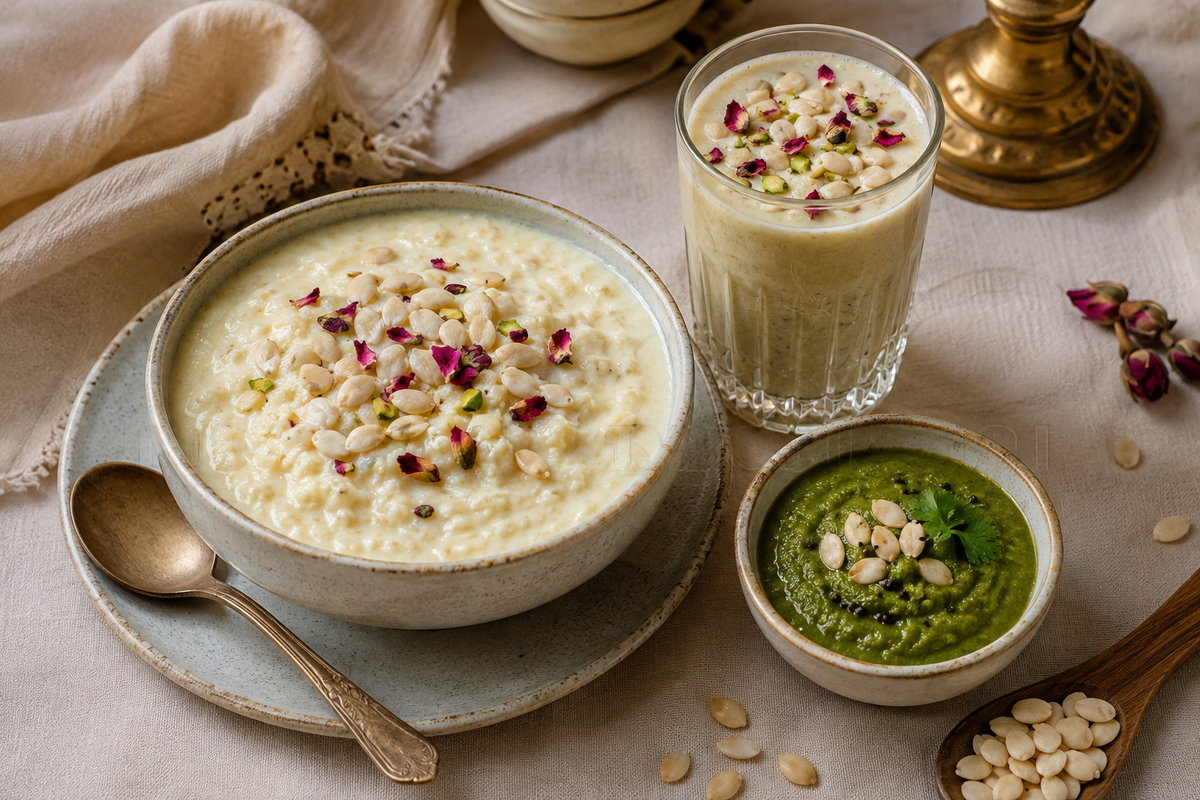
Magaz can be creamy, crisp or softly nutty depending on how you prepare it. Soak watermelon seed kernels when you want them to disappear into thandai or a smooth paste. Toast them when you want aroma and crunch. Use both methods in kheer when you want a creamy base with whole kernels running through it.
This guide gives you three flexible recipes: a gentle magaz kheer, a fragrant thandai and a savoury green chutney. Each recipe begins with dried, shelled watermelon seed kernels—not whole black seeds with the shell attached.
Quick preparation guide
| Dish | Best preparation | Why |
|---|---|---|
| Kheer | Soak and grind some; lightly toast some | Creaminess plus a delicate bite |
| Thandai | Soak, then blend very finely | Smoother drink and easier straining |
| Chutney | Dry-roast, cool, then grind | Deeper flavour and a thicker finish |
Recipe 1: Creamy magaz kheer
This kheer uses a two-texture method. Half the kernels are ground into the milk and half are kept whole. The result tastes rich but not heavy, and the magaz remains recognisable.
Ingredients
Serves 4
- 1/2 cup shelled watermelon seed kernels (magaz), divided
- 750 ml full-fat milk
- 1 teaspoon ghee
- 3 to 4 tablespoons sugar, or to taste
- 1/2 teaspoon green cardamom powder
- 8 to 10 saffron strands, optional
- 1 tablespoon chopped pistachios or almonds, optional
- A few dried rose petals, optional
Method
- Soak half the magaz. Cover 1/4 cup kernels with warm water for 30 minutes. Drain, then blend with 3 to 4 tablespoons of milk until smooth.
- Toast the remaining kernels. Warm the ghee in a heavy pan over low heat. Add the remaining 1/4 cup magaz and stir for 2 to 3 minutes, just until fragrant. Do not darken them.
- Cook the paste. Lower the heat and add the ground magaz paste. Stir continuously for 2 minutes so it cooks evenly without catching.
- Add the milk. Pour in the milk gradually while stirring. Add saffron if using. Bring to a gentle simmer, then cook uncovered for 20 to 25 minutes, stirring every few minutes and scraping the base of the pan.
- Sweeten. Add sugar and cook for another 4 to 5 minutes. Stir in cardamom.
- Rest and serve. Turn off the heat. The kheer will thicken as it cools. Serve warm, at room temperature or chilled, topped with nuts or rose petals.
If you prefer jaggery
Milk can split when jaggery is added at a full boil, especially if the jaggery is acidic or contains impurities. Cook the kheer without sugar, switch off the heat and let it cool for 8 to 10 minutes. Melt grated jaggery separately with a spoonful of water, strain if needed, then stir it into the warm—not boiling—kheer. Do not return it to a hard boil.
Make it lighter
Use 500 ml milk plus 250 ml water and reduce the sugar. The texture will be looser, so simmer a little longer. For a rice-and-magaz kheer, add 2 tablespoons of washed, soaked rice with the milk and extend cooking until the rice is completely tender.
Kheer troubleshooting
- Too thick: stir in warm milk a little at a time.
- Too thin: simmer uncovered on low heat; it will also thicken while cooling.
- Grainy paste: soak longer and blend first with only a small amount of liquid.
- Scorched flavour: use a heavy pan, low heat and frequent stirring; once milk catches badly, transferring the upper layer cannot fully remove the taste.
Recipe 2: Fragrant homemade thandai with magaz
Magaz gives thandai a naturally full texture and a mellow base for fennel, pepper, cardamom and rose. This version is aromatic rather than aggressively spiced. Adjust black pepper to your preference.
Ingredients
Makes about 4 glasses
- 3 tablespoons shelled watermelon seed kernels
- 12 almonds
- 1 tablespoon fennel seeds
- 1 teaspoon poppy seeds, optional and subject to local availability
- 8 black peppercorns
- Seeds from 5 green cardamom pods
- 1 tablespoon dried rose petals, food-grade
- 1 small pinch saffron, optional
- 750 ml chilled milk
- 3 to 5 tablespoons sugar, according to taste
- 1 teaspoon rose water, optional
- Ice, optional
Method
- Soak the base. Put magaz, almonds, fennel, poppy seeds if using, peppercorns, cardamom and rose petals in a bowl. Cover with fresh water and soak for 4 hours or overnight in the refrigerator.
- Peel if desired. Slip the skins off the almonds for a paler, smoother drink. This step is optional.
- Make a fine paste. Drain the soaking water. Blend the soaked ingredients with about 150 ml of the milk. Stop, scrape the jar and blend again until very smooth.
- Combine. Add sugar, saffron and another 200 ml milk. Blend once more, then pour into a jug with the remaining milk.
- Strain or keep whole. For a refined texture, press through a fine sieve or muslin. For a thicker whole-food drink, skip straining and stir before serving.
- Chill. Add rose water, taste and adjust sugar or pepper. Refrigerate for at least 1 hour and serve cold.
Make-ahead thandai paste
Blend the soaked ingredients with just enough water to make a thick paste. Refrigerate in a clean airtight container and use within 24 hours. To serve, blend roughly 2 generous tablespoons of paste with 200 ml cold milk and sweetener. For longer storage, freeze measured spoonfuls in a clean tray and transfer them to a sealed container once frozen.
Dairy-free option
Use an unsweetened oat, soy or almond drink. Soy brings more protein; oat gives a naturally soft texture. Because plant drinks vary in sweetness and thickness, add sugar only after blending and tasting.
Recipe 3: Roasted magaz green chutney
This chutney is fresh, creamy and savoury without needing coconut or a large quantity of peanuts. Serve it with idli, dosa, cheela, sandwiches, parathas, pakoras or a simple rice-and-dal plate.
Ingredients
Makes about 1 cup
- 1/2 cup shelled watermelon seed kernels
- 1 packed cup coriander leaves and tender stems
- 1/2 cup mint leaves
- 1 to 2 green chillies
- 1/2 inch fresh ginger
- 1/2 teaspoon roasted cumin powder
- 1 to 2 tablespoons lemon juice
- 1/2 teaspoon salt, or to taste
- 4 to 8 tablespoons cold water, as needed
Method
- Roast. Put the magaz in a dry pan over low heat. Stir continuously for 3 to 4 minutes until aromatic with a few pale-gold spots.
- Cool completely. Hot seeds trap steam in the grinder and can turn oily before the chutney becomes even.
- Grind the base. Pulse the cooled kernels alone a few times to make a coarse meal.
- Add the fresh ingredients. Add coriander, mint, chilli, ginger, cumin, lemon and salt. Start with 4 tablespoons water and blend.
- Adjust. Add water one tablespoon at a time until the chutney reaches the texture you want. Taste and balance salt, heat and acidity.
Three easy variations
- Curd-magaz dip: fold 3 tablespoons thick chutney into 1/2 cup whisked curd.
- Red chilli chutney: replace mint and green chilli with 2 soaked dried red chillies; add a small piece of tamarind and one garlic clove.
- Coconut-magaz chutney: blend 1/4 cup roasted magaz with 1/2 cup fresh coconut, green chilli, ginger and curd or water; finish with a mustard-seed tempering.
Storage
Fresh herb chutney is best on the day it is made. Refrigerate promptly in a clean airtight container and use within 1 to 2 days. Use a dry, clean spoon each time. If the chutney develops an off smell, bubbling or unusual discoloration, discard it.
How to make a smooth magaz paste
The secret is to begin thick. A small blender jar works better than a wide jar for modest quantities.
- Soak at least 1/4 cup kernels so the blades have enough volume to catch.
- Drain thoroughly.
- Add only 2 to 3 tablespoons of fresh liquid at first.
- Blend, scrape the sides and repeat.
- Add more liquid only after the paste is already smooth.
For savoury dishes, use water. For sweets and drinks, use milk. If the final recipe will be cooked, the paste does not need to be perfectly white; a slightly coarse texture often disappears during simmering.
Can magaz replace cashews or almonds?
Often, yes. In a gravy or chutney, replace cashews with an equal weight of soaked magaz and adjust liquid gradually. The flavour will be more neutral and the sauce may feel slightly lighter. In thandai, replacing every almond changes the familiar aroma, so a half-magaz, half-almond base is a good first experiment. In kheer, magaz can stand alone or be paired with a smaller garnish of almonds and pistachios.
More ways to use the same packet
- Toast and sprinkle over poha, upma or salads.
- Blend into a mild seed butter with a pinch of salt.
- Grind and mix into atta.
- Add to date-and-coconut laddoos.
- Use a spoonful in soup or vegetable gravy.
For exact everyday ideas, read five easy ways to use watermelon seeds every day.
Frequently asked questions
Do I have to remove a shell from magaz?
No. Magaz sold as a pale kernel is already shelled. Whole black or mottled watermelon seeds are a different form and will not blend into these recipes in the same way.
Why did my thandai feel gritty?
The kernels or almonds may not have soaked long enough, or too much milk may have been added at the start. Blend the solids first with a small quantity of liquid, then dilute. Straining is optional but gives the smoothest finish.
Can I roast magaz in ghee?
Yes, especially for kheer and halwa. Use low heat and only enough ghee to coat the pan. For chutney or a savoury garnish, dry-roasting keeps the flavour more flexible.
Is magaz the same as char magaz?
Not necessarily. Pure magaz in this guide is watermelon seed kernel. Char magaz is a four-seed blend whose exact composition can vary. Learn more in our complete introduction to magaz.
Does magaz need refrigeration?
Unopened storage depends on the pack. After opening, keep the kernels airtight, cool and dry. Refrigeration is a good choice in hot or humid weather because the natural oils can become stale.
Explore the ingredient: Watermelon Seed Kernels (Magaz)


