

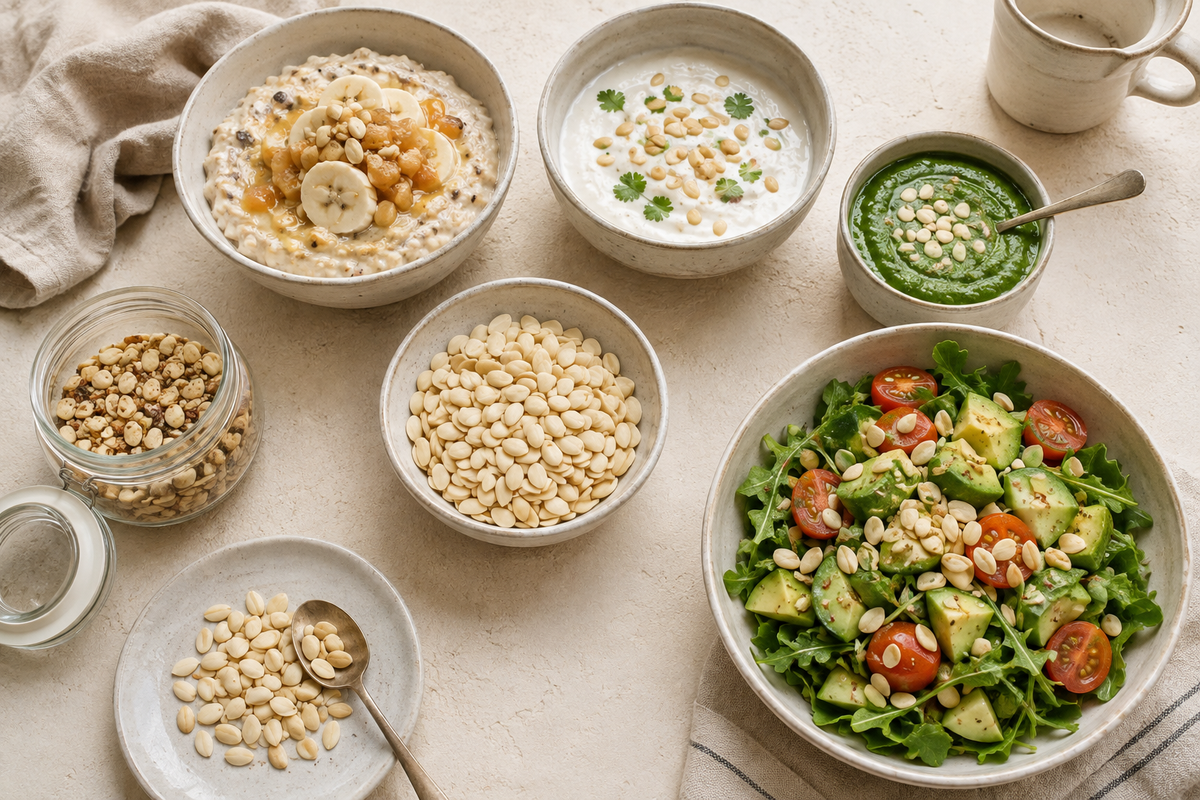
Shelled watermelon seeds, commonly called magaz, are one of those pantry ingredients that can disappear into a recipe or stand proudly on top of it. Their flavour is mild, their texture changes beautifully with heat or soaking, and you do not need a complicated recipe to use them.
If your packet of magaz has been waiting for a special occasion, bring it into the everyday kitchen. The simplest starting amount is 1 to 2 tablespoons. That is enough to add a little crunch to breakfast, creaminess to a drink or body to a chutney without redesigning the whole meal.
Before you begin: raw, roasted or soaked?
Choose the preparation according to the result you want:
- Use raw kernels when they will cook inside porridge, kheer or a gravy.
- Dry-roast them when you want crunch and a deeper nutty aroma.
- Soak them when you want a smooth milk, shake, paste or sauce.
To dry-roast, place the kernels in a clean pan over low heat. Stir for 2 to 4 minutes and remove them as soon as they smell nutty. To soak, cover with warm water for 20 to 30 minutes, drain and blend. Long soaking is not necessary for most uses, although overnight soaking can be convenient for breakfast drinks.
1. Sprinkle roasted magaz over breakfast and chaat
The quickest way to use watermelon seed kernels is to treat them like a finishing ingredient. Dry-roasting makes them crisp enough to stand in for chopped nuts or other seeds.
Everyday breakfast bowl
Add 1 tablespoon of roasted magaz to a bowl of yoghurt, curd, oats, porridge or chopped fruit. Pair it with banana and cinnamon for a soft, sweet bowl; with apple and cardamom for a familiar Indian flavour; or with unsweetened curd, cucumber and roasted cumin for a savoury breakfast.
Poha, upma and chaat
Scatter the kernels on poha or upma just before serving so they stay crisp. For chaat, combine 1 tablespoon magaz with roasted chana, onion, tomato, coriander, lemon and chaat masala. The kernels bring the richness that peanuts often provide, but with a gentler flavour.
Make a small seed topper
Mix equal parts roasted magaz, sesame and pumpkin or sunflower seeds. Add a pinch of salt and roasted cumin. Store in an airtight jar and use 1 tablespoon at a time over dal, sabzi, salads or soup. Make only enough for two weeks so the mixture stays fresh.
2. Blend watermelon seeds into lassi, smoothies or breakfast milk
Soaked magaz blends into a creamy base without a strong seed flavour. It works especially well when you want body in a drink but do not want banana, cream or a large quantity of nuts.
Simple magaz breakfast drink
- 2 tablespoons watermelon seed kernels
- 250 ml milk or an unsweetened plant drink
- 1 small banana or 2 soft dates
- A pinch of cardamom
Soak the kernels for 20 to 30 minutes. Drain, then blend them first with a small splash of the milk until smooth. Add the remaining ingredients and blend again. Starting with less liquid helps the blades break down the small kernels more evenly.
For a savoury version, blend soaked magaz with thin curd, cucumber, mint, roasted cumin and a little salt. Serve it immediately rather than storing it for the next day.
Texture tip
If your blender is not powerful, grind the soaked kernels in a small chutney jar before adding the rest of the drink. You can strain the mixture, but keeping it unstrained retains more of the whole-food texture.
3. Use magaz paste to thicken gravies and soups
A paste made from soaked watermelon seed kernels can replace part or all of the cashew paste in many gravies. It makes a sauce feel fuller while keeping the flavour relatively neutral.
Basic magaz paste
- Soak 4 tablespoons of kernels in warm water for 30 minutes.
- Drain and blend with 3 to 5 tablespoons of fresh water.
- Scrape down the jar and blend again until smooth.
- Add the paste to cooked onion-tomato masala over low heat.
- Cook for 3 to 5 minutes, stirring, before adding the main liquid.
This quantity suits a gravy for roughly four people. Use it in vegetable kofta curry, matar gravy, paneer dishes or a mild mixed-vegetable sauce. It can also thicken pumpkin, carrot or tomato soup: add 1 to 2 tablespoons of paste near the end, simmer briefly and adjust the seasoning.
Avoid splitting or sticking
Do not add a cold, thick paste to furiously boiling liquid. Lower the heat, stir it into the masala, and add water gradually. A heavy-bottomed pan helps because seed pastes can settle.
4. Fold magaz into kheer, atta and simple sweets
You do not need to wait for a festival to use magaz in something sweet. A spoonful works in weekday porridge; a larger amount can become part of a traditional dessert.
In kheer or porridge
Dry-roast 2 tablespoons of kernels and add them during the final 5 minutes of cooking. For a creamier result, grind 1 tablespoon and keep 1 tablespoon whole. The powder disappears into the milk while the whole kernels remain visible.
In atta
Pulse roasted magaz into a coarse meal and add 1 to 2 tablespoons to every cup of atta. Use it in rotis, thepla or lightly sweetened breakfast parathas. Because ground seeds contain natural oils, grind only what you need and use it promptly.
Quick date-and-magaz bites
Pulse 1 cup soft dates with 1/2 cup roasted magaz, a pinch of cardamom and 2 tablespoons desiccated coconut. Roll into small balls and refrigerate in an airtight container. These are rich, so keep them bite-sized.
For a more traditional method with exact quantities, follow our guide to magaz kheer, thandai and chutneys.
5. Turn roasted watermelon seeds into chutney or dip
Magaz makes a useful chutney base because it balances sharp ingredients and thickens the mixture. Roasting first adds flavour and prevents the chutney from tasting flat.
Everyday green magaz chutney
- 1/3 cup dry-roasted watermelon seed kernels
- 1 packed cup coriander leaves
- 1/2 cup mint leaves
- 1 green chilli
- 1/2 teaspoon roasted cumin
- 1 to 2 tablespoons lemon juice
- Salt and water as needed
Cool the roasted kernels completely. Blend everything with a few tablespoons of water, adding more only until the blades move. Taste before adding extra lemon or chilli. Serve with idli, cheela, sandwiches, parathas or a simple dal-rice meal.
Make it a dip
Stir 2 tablespoons of the thick chutney into 1/2 cup curd. Add grated cucumber and a pinch of salt. The result works as a vegetable dip, sandwich spread or cooling side for a spicy meal.
A simple seven-day routine
There is no need to use magaz in every meal. A loose routine makes the ingredient easy to remember without becoming repetitive:
- Monday: roasted kernels on poha.
- Tuesday: a spoonful in curd and fruit.
- Wednesday: magaz paste in vegetable gravy.
- Thursday: the green chutney with cheela.
- Friday: a banana-cardamom breakfast drink.
- Saturday: seed topper over salad or soup.
- Sunday: kheer, thandai or a small homemade sweet.
Use this as inspiration, not a rule. The larger goal is variety: rotate magaz with dals, beans, vegetables, fruits, whole grains and other nuts or seeds.
Common mistakes to avoid
- Roasting on high heat: the kernels can scorch before the centre warms.
- Grinding while hot: trapped steam creates moisture and can turn a dry meal into a sticky paste.
- Adding too much water at once: a paste or chutney becomes thin before it becomes smooth.
- Storing beside the stove: heat speeds up flavour deterioration in oil-rich seeds.
- Assuming every “melon seed” mix is pure watermelon seed: check the ingredient list, especially for char magaz.
Frequently asked questions
Can watermelon seed kernels be eaten without roasting?
Yes, shelled kernels can be used raw if the pack is intended for direct food use. Roasting is mainly for flavour and crunch. Follow any preparation instructions printed on your pack.
How many watermelon seeds should I eat?
There is no universal number. For a practical food portion, begin with 1 to 2 tablespoons and consider the rest of the meal. Nuts and seeds are nutrient-rich but also energy-dense.
Can children eat magaz?
Use an age-appropriate texture. Whole kernels may be a choking risk for young children, so finely ground paste or powder is safer when advised by the child’s caregiver or clinician. Avoid the ingredient in anyone with a known seed allergy.
How long does roasted magaz stay fresh?
Roast small batches and store them airtight after they are completely cool. In a cool cupboard, aim to use them within about two weeks for the best flavour; refrigerate in hot or humid conditions.
New to the ingredient? Read what magaz is and how Indian kitchens use it. If nutrition is your main interest, continue with magnesium and zinc in watermelon seeds.
Explore the ingredient: Watermelon Seed Kernels (Magaz)


